Daniel Johnson
Who am I?
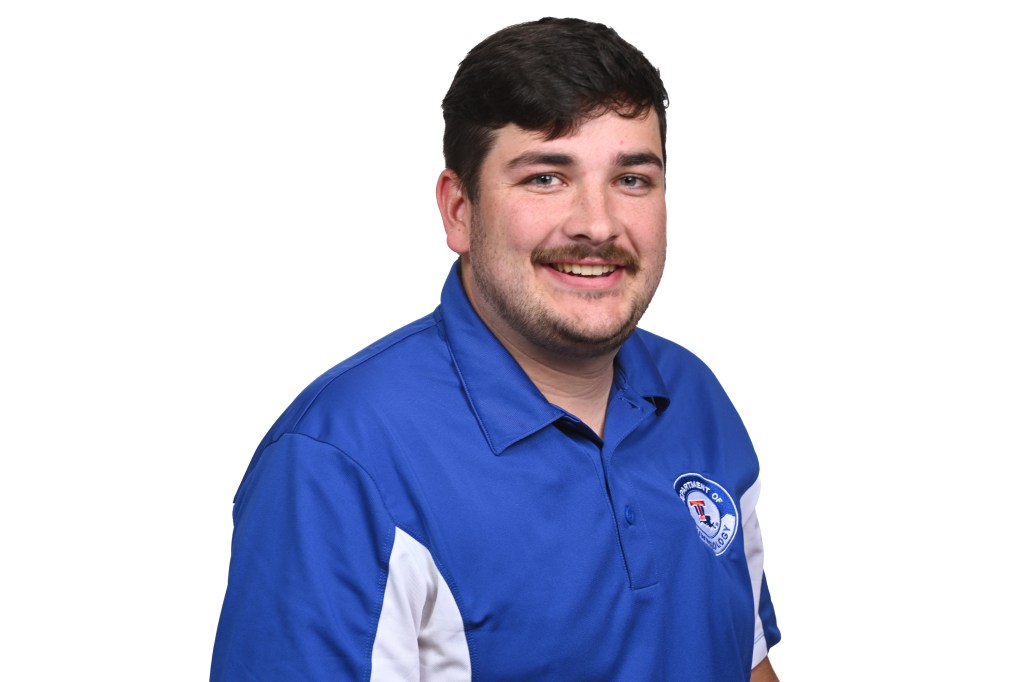
I am Daniel Johnson, a second-year graduate student in the Sports and Exercise Psychology master’s concentration. I am from El Dorado, Arkansas and came to Louisiana Tech in 2018 where I started my bachelor’s degree in psychology. I completed my undergraduate degree in Spring 2022, where I immediately started my master’s degree in Sports and Exercise Psychology. I plan to graduate this winter quarter, then pursue a career in cognitive training in a military setting.
CRAFT (Comprehensive Readiness for Aircrew Flying Training)
My internship at Barksdale Air Force Base in Bossier City, LA is under a program called CRAFT, a human performance initiative that is put in place by Air Force Global Strike Command that emphasizes an investment in the Air Force’s most important asset – the airmen. CRAFT is a holistic human performance curriculum designed to target physical and mental training objectives to improve student learning, performance, problem solving, and stress management. CRAFT is a nationwide program at an undergraduate level, where the students spend a couple of days a month doing a variety of introductory training that the air force hopes the students find valuable enough to implement into their career with minimal instruction. At Barksdale CRAFT; however, the students aren’t in undergraduate training, they are in the Initial Qualification Training (IQT) stage of their careers, where they already know what airplane they will spend their careers on.
Barksdale Air Force Base is the only base in the nation that is doing this training at a graduate-level, and for this reason it is considered a pilot program. The program luckily has a real-world control group, meaning that they had an IQT class come through that was trained the “old way”, but was still assessed to quantify their improvement within the former parameters of training. A big part of what they are currently doing at CRAFT Barksdale is attempting to prove that there is a statistically significant difference between relative improvement in the experimental groups as opposed to the control group that was surveyed. If the program is determined to be significantly more effective than what was previously in place, then CRAFT will expand to operational squadrons, different aircraft, and far down the line, commercial pilot training. In short, I have been afforded the opportunity to be on the ground floor of what I think is going to have massive ramifications for a population I never intended to work with.
CRAFT performs extensive pre, midline, and post assessments to not only help track the improvement of the students on different skills, but also to have a profile on the students clear enough to see where the relative deficiencies are. I have now helped with 4 different groups of assessments, where I help administer everything from iPad attention span assessments, to simple eye exams. The results of these assessments are electronically cataloged and immediately analyzed by CRAFT Barksdale’s lead scientist, Dr. Johannes Rabbe. He performs an assortment of statistical tests to determine how much a student is improving between assessments. This is very valuable, especially during midline assessment, because we can determine which approach during the first half of IQT was effective or not for that particular student.
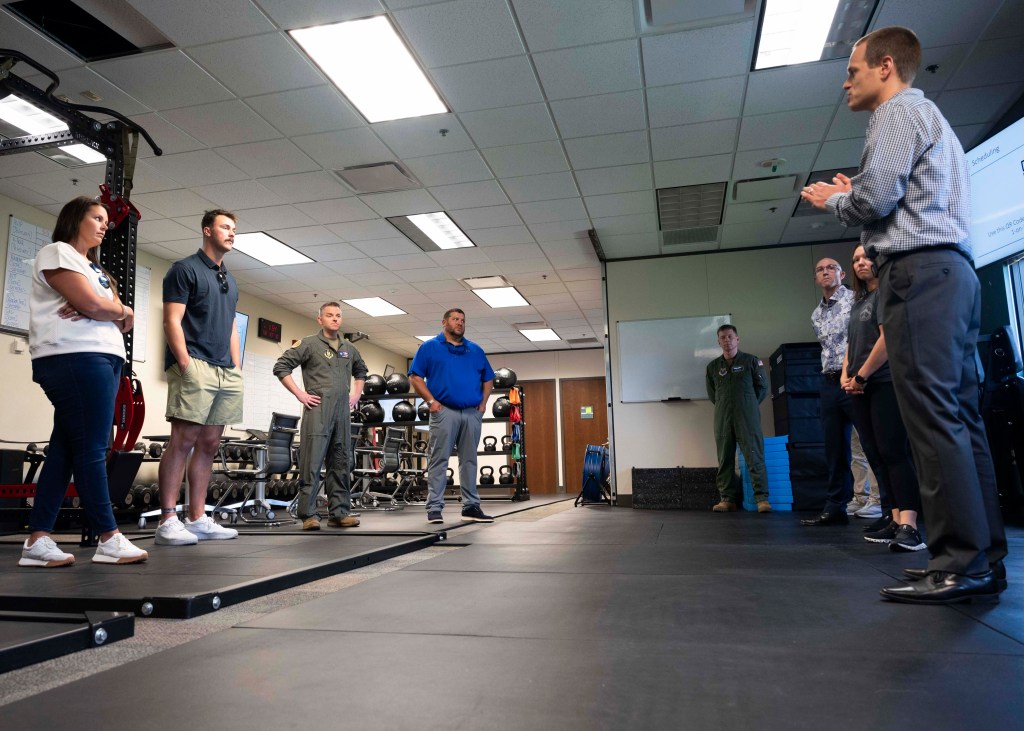
CRAFT is divided into two sections: the academic phase and the flightline phase. During the academic phase, Dr. Tucker Readdy, a cognitive performance specialist within CRAFT, teaches classes once a week on a variety of skills and ideas ranging from a class on personality types, to a class labeled “the psychology of killing”. This is far from the only class that the IQT students participate in, as they are required to learn not only the ins and outs of their own jet, but also the why’s and how’s associated with protocol on the jet and what makes it fly. During this time, the students don’t have any individual cognitive performance trainings, but do participate in blended physical and cognitive trainings (coined STRIKER trainings) twice a week, where they expend a lot of energy doing some sort of physical activity, and then are instructed on some sort of cognitive training while under “stress conditions”.
During the Flightline Phase, the students spend a lot of time with the CRAFT team. At this stage’s, all students have passed their academics and are now getting hands-on experience with the jet. Whereas before, we saw the students twice a week, the students now participate in 2 individual CPS trainings in addition to the 2 striker trainings they were already performing in the academic phase. While I assist in the striker training, they aren’t catered to the individual. They are all about overarching skills that CRAFT attempts to improve and every student does the same amount of training for each skill, provided they do not miss some for unforeseen circumstances. The CPS sessions; however, are catered to what the individual may or may not need depending on what his or her assessment scores show.
What Do I Do For CRAFT?
I have a lot of traditional “intern” tasks, such as manually inputting data, cleaning equipment, and setting up the training space for a variety of trainings. However, that is far from all that I do. I work closely with Ms. Bailey Thompson, a cognitive performance specialist, administering the cognitive components of the striker training. We administer different exercises emphasizing the 4 main focuses of CRAFT training: eye/hand coordination, logical reasoning/decision making, working memory, and perception training. Sometimes, that training looks very simple, like throwing different colored bean bags at a student where each color bag has a different mandated response (red=catch with right hand, blue=catch with left hand). Other times, the students are hooked up to low grade EEGs on their head and are told to try and keep their brain waves at a “relaxed” level all while doing a target acquisition task.
In the CPS sessions, my involvement varies. Occasionally, I am asked to help perform a training session that may need more than one set of hands to administer properly, or if Dr. Readdy thinks that a student values 1-on-1 instruction within their learning environment. Depending on the task, it may be much more conducive for the students to only hear from one instructor, and in that case, I still get beneficial experience by discussing the hows and whys of a specific training with Dr. Readdy before and after the session, learning what training correlates with what skill deficit. Regardless of the way the training is administered, I get valuable experience in terms of watching the theories discussed in my classes at Louisiana Tech applied in the field. I get to talk about the theory that a training is based on before we administer it, and I am always allowed to give feedback and be as involved as I feel comfortable in regards to providing feedback and making suggestions on improvement.
My Professional Interests
Originally, when joining the Sports and Exercise Psychology master’s program, I only wanted a career exclusively in professional or collegiate sports. Part of that is because I am passionate about sport, but also because I was ignorant of how broad sports and exercise psychology reached in terms of career paths. When attempting to find an internship, I did not get far into my search when the opportunity arose for a Louisiana Tech graduate student to go to Barksdale Air Force Base for an internship with their cognitive performance staff. While I had no prior interest in a military population, I was approached by Dr. Parks, Dr. Blazo, and Dr. Reichter to carry out the internship because I was one the only graduate student in the master’s program looking for an internship at the time. I am a person that holds Christian beliefs and I think there were too many signs pointing toward this internship to ignore. For one thing, I had a hard time finding any worthwhile internships within sport, and there were no opportunities that would allow me to commute, therefore, I would have to move to a different state for a quarter to complete an internship. Even more of a cool coincidence is that the CRAFT program was centered around student airmen training to operate the B52 bomber, and while that is not only the oldest plane still used by the military, but also the same one my grandfather helped operate while serving in the Vietnam War. I never had plans to serve in the military, but this internship allowed me to get valuable experience while helping train the next generation of airmen on a plane with a storied history. Throughout my internship, I discovered a new passion for training a population with way more importance than I ever thought my career could carry, and I am only an intern! I cannot wait to pursue an influential career in military training.

 The Exponential Factor