
Dee Fleming, B.S. Louisiana Tech University Kinesiology and Health Sciences

Throughout my time at Louisiana Tech and the Kinesiology Department, I was always supported by my instructors and felt at home. The courses provided in Kinesiology prepared me for so much more than I could ever imagine. During my time in college, I had the opportunity to volunteer and participate in the Rock Steady Boxing classes provided for patients with Parkinson’s Disease. Fast forward to today, and partnering with Rock Steady Boxing and Parkinson’ssupport groups is one of my favorite roles of my current career.

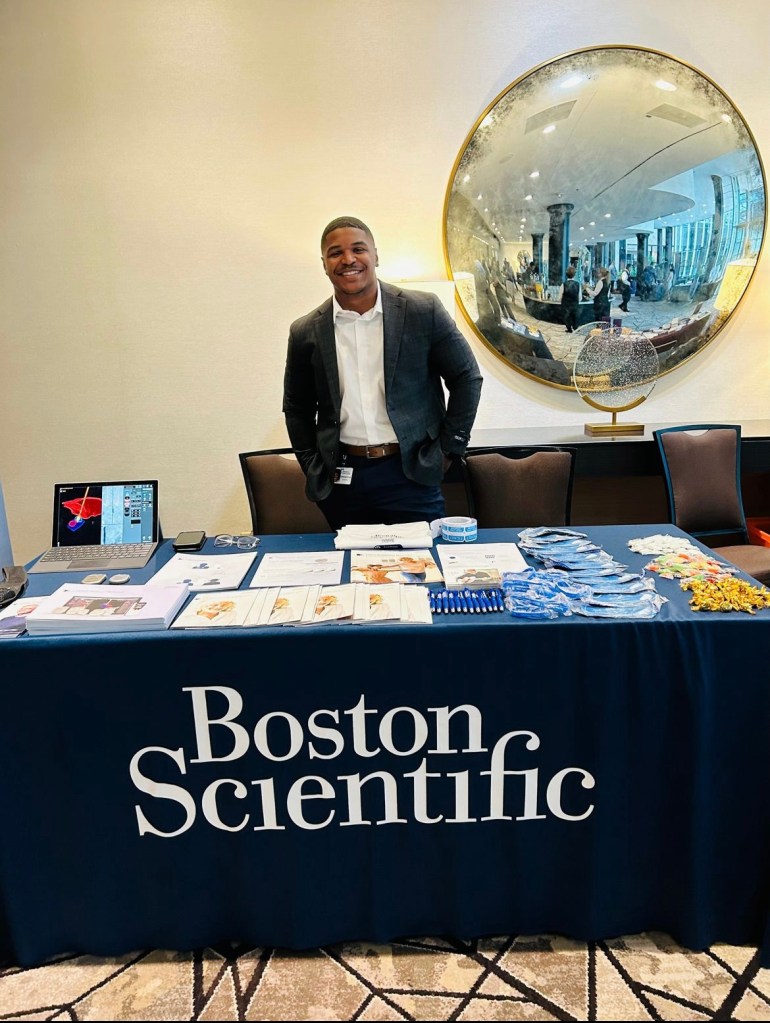
I am currently a Business Development/Therapy Awareness Manager for Boston Scientific Deep Brain Stimulation. Deep Brain Stimulation (DBS) is an amazing therapy provided to improve the motor symptoms caused by Parkinson’s Disease and Essential Tremor. This is achieved by performing a minimally invasive surgical procedure in the brain, where the patient is awake, so we can monitor symptoms and brain activity during the operation. During this procedure, the patient will be implanted with leads and a battery to power the electrical stimulation that will be providing the therapy. The ultimate goal is to help those diagnosed with Parkinson’s Disease and Essential Tremor, receive their quality of life back.
There are a few components involved in the process of DBS. The first step of DBS is the Stage 1 procedure, which involves the neurosurgeon placing leads into the specific structures in the brain that can provide the best therapy and decrease of symptoms for the patient. With these structures being so small and there being several other structures in the brain we want to avoid, the procedure is done in millimeter increments. As mentioned before, this step involves testing during the procedure, by one of us connecting our clinical programmer (Microsoft tablet), to the microelectrodes or leads and increasing amplitude of electrical stimulation. During this process, the patient is awake while we monitor tremor, rigidity (stiffness), and bradykinesia (slow movements). Every testing method may be different as we ask them to perform several movements or actions, such as drawing spirals on a piece of paper before and after we turn on stimulation. There are several videos available on the internet that show musicians being given an instrument to play during the procedure, such as a violin, which was very difficult to do after being diagnosed with Parkinson’s or Essential Tremor. While decreasing motor symptoms are our goal, we also focus on not applying stimulation to structures that may cause unwanted side effects; this is where our Image Guided Programming software is very helpful and accurate. Once the leads are where they need to be and therapy has great results, the incisions are closed, and the patient is given time to recover in the facility before returning home. This gives the patient and brain an opportunity to rest and heal before the next procedure.
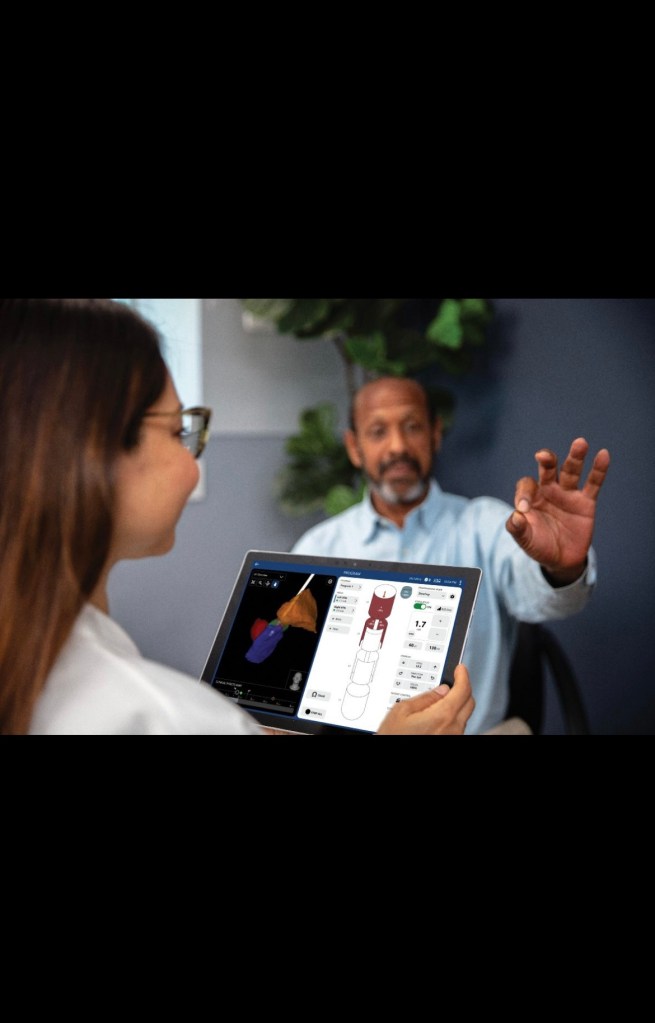
In the next step, this is a procedure that consists of surgically placing the battery into a small pocket inside of the chest and connecting it to the leads and its extensions. While there are several differences, the placement is similar to a pacemaker. One difference I always like to point out, are our batteries are MRI conditional, which means the patient still has the ability to get MRI scans and imaging. Once everything is connected, we test the battery and leads to make sure that there are no connectivity issues or impendences before we conclude the procedure. The patient is normally sent home the same day to rest and heal. The next time we see them, will be at their neurologist’s clinic for the initial programming, where we turn the system and stimulation on.
My very first initial programming humbled me. There are a lot of things that we take for granted, whether it’s being able to pick up a fork and eat, pour and drink our coffee, scroll through our phones, play with loved ones, and etc. Working in this field has made me so much more appreciative, but also so happy for those who decided to follow through with DBS. The initial programming can be very emotional sometimes as patients are able to do things, they weren’t able to do for some time. During my first initial programming I saw, the patient was given a cup and asked to imagine water was in it, and to raise to her mouth for a drink. It was honestly heartbreaking to see that she couldn’t raise the cup to her mouth or drink without a significant amount of tremor. She also stated that often, most of the drink ends up on her clothes. We turned on stimulation, monitoring her as we increased amplitude. We gave her the cup again and asked her to imagine she was taking a drink. At this exact moment, I remember getting chill bumps and seeing her husband beside her in disbelief, as she was able to drink with no tremor or issues at all. Seeing the tears flow, seeing the rejoice, makes me love my job and what I do. Coming from an emergency medicine and law enforcement background prior to medical device, purpose was always something I wanted to seek in my next career. I’ve found just that. I get to work with a phenomenal company and team. I get to partner with motivated neurologists and neurosurgeons who are looking to improve the care available for patients. I get to serve some amazing people.
So thank you Louisiana Tech Kinesiology for preparing me for these moments and giving me the knowledge and experience needed. Thank you for always motivating and believing in me.

 The Exponential Factor